
 OffroadAdmin
Shopping for new wheels should be the fun part of building out your Jeep. But when someone mentions bolt pattern, the fun grinds to a halt, because getting the wrong wheels leaves you with a great-looking purchase that will never touch your Jeep. So, before you drop money on new rims, it’s important to understand your Jeep’s bolt pattern first.
What Is a Jeep Bolt Pattern, Exactly?
A bolt pattern is written as two numbers, like 5×5″. The first number is how many lug nuts hold the wheel on. The second is the diameter (in inches) of the circle those lug nuts form if you drew a line through their centers. A 5×5″ Jeep bolt pattern means five lug nuts arranged around a 5-inch circle.
You will also see that pattern written in millimetres, like 5x127mm, and that trips people up more than it should. It is not a different pattern, just the same one in a different unit: 5×5″ and 5x127mm describe the exact same bolt circle. Multiply inches by 25.4, and you land on the millimetre figure every time.
What a bolt pattern will not tell you is whether a wheel clears your brakes, fenders, or suspension. That comes down to offset and backspacing, which are separate measurements entirely. Two wheels can share the exact same Jeep bolt pattern and still look completely different mounted on the Jeep, since one sits deeper in the wheel well than the other.
How Bolt Patterns Differ Across Jeep Models
Remember, not every Jeep shares the same bolt pattern, and knowing which one your vehicle uses saves you from ordering the wrong wheels twice.
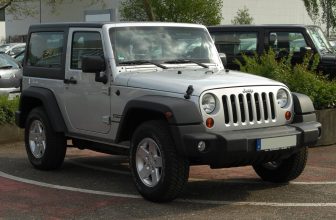
Wrangler (YJ, TJ, JK, JL)
The Wrangler is the one Jeep that will bite you if you assume every generation matches. It has run two different bolt patterns over the years, and mixing them up is the most common wheel-shopping mistake we see.
| Generation | Years | Bolt Pattern | Metric Equivalent |
| YJ | 1987–1995 | 5×4.5″ | 5×114.3mm |
| TJ | 1997–2006 | 5×4.5″ | 5×114.3mm |
| JK | 2007–2018 | 5×5″ | 5x127mm |
| JL | 2018–present | 5×5″ | 5x127mm |
The JK and JL share the same 5×5″ bolt circle as the Gladiator, but the wheels are not automatically interchangeable. JL and Gladiator models switched to 14mm lug studs, while the JK used 1/2-inch studs, so a wheel built for one will not bolt onto the other, even though the pattern matches. So, always check stud size along with bolt pattern before you buy.
Grand Cherokee (ZJ, WJ, WK, WK2)
The Grand Cherokee also switched bolt patterns partway through its life. The ZJ, sold through the 1990s, have a 5×4.5″ (5×114.3mm) bolt pattern, the same one found on the Cherokee XJ and early Wranglers. Every generation after that, the WJ, WK, and WK2, covering 1999 onward, moved to 5×5″ (5x127mm), matching the JK, JL, and Gladiator. Wheels built for a modern Wrangler will bolt right up on a newer Grand Cherokee.
Cherokee & Liberty (XJ, KJ)
The Cherokee XJ and Liberty KJ are the easy ones. Both have a 5×4.5″ (5×114.3mm) bolt pattern for their entire run, the same as the YJ, TJ, and ZJ, so wheels swap freely between all of them without an adapter.
Gladiator (JT)
The Gladiator JT have the same 5×5″ (5x127mm) bolt pattern as the JL Wrangler, with the same 14mm lug studs, so JL wheels bolt straight onto a Gladiator and vice versa. That makes the JT one of the easier trucks in the lineup to shop wheels for, since anything built for a modern Wrangler already speaks the same language.
Don’t Buy Wheels Until You Read This
Bolt pattern is the first box to check, but it is not the only one:
- Hub-centric vs lug-centric fit. A hub-centric wheel uses the vehicle’s hub to center itself, with the lug nuts mainly providing clamping force. A lug-centric wheel relies on the lug nuts to stay centred. Most factory and quality aftermarket wheels are hub-centric, which keeps the wheel running true.
- Wheels do not always swap between generations. Matching bolt pattern numbers is a good start, but stud size, center bore, and offset need to line up, too. A JK wheel matches a JL’s bolt pattern but not its stud size, so it is not a guaranteed swap.
- Adapters and spacers are not automatically safe. A quality hub-centric adapter, installed correctly and torqued to spec, can safely change your bolt pattern. A cheap lug-centric adapter, or one stacked on top of another, is how people end up with a wheel that walks loose at speed.
- Torque matters as much as the pattern. Most 5×4.5″ and older 5×5″ Jeeps (YJ through JK) torque to around 95 to 100 ft-lb, while JL and Gladiator models with 14mm studs run higher, often closer to 130 ft-lb. Confirm the exact spec in your owner’s manual and torque in a star pattern. Canada’s own vehicle safety standards for tires and rims exist for exactly this reason.
Keep in mind that skipping any of these is, unfortunately, how many Jeepers end up with wheels that look perfect but never sit right on their Jeep.
Best Wheel Upgrades Based on Bolt Patterns
Once you know your Jeep bolt pattern, shopping gets a lot easier, since you can rule out anything that will not fit before you even click into a listing. Thankfully, Just Jeeps carry wheels built for all bolt patterns, even for rare 6×5.5.
Enthuze Steel Wheel

Bolt Pattern: 5×5
Built on the 5×5″ (5x127mm) Jeep bolt pattern, which covers JK and JL Wranglers, the Gladiator JT, and Grand Cherokee WJ/WK/WK2 models. At 17×7 with a 71.5mm center bore and ET40 offset, it bolts straight onto that hub with no adapters or spacers needed. A steel wheel in this pattern is a budget-friendly pick for factory-correct fitment.
Rough Country Steel Wheel Chrome

Bolt Pattern: 5×5
Like the Enthuze wheel above, this chrome steel wheel is built on the 5×5″ (5x127mm) Jeep bolt pattern shared by JK and JL Wranglers, the Gladiator, and later Grand Cherokee models. At 17×9 with a 3.30″ bore, it runs wider for a more aggressive stance, while still bolting up factory-correct on any Jeep running that pattern. The chrome finish dresses up a Jeep without touching the fitment side of the equation.
Rough Country Steel Simulated Bead Lock Wheel Black

Bolt Pattern: 6×5.5
This wheel runs a 6×5.5″ bolt pattern, a configuration you will not find on a Wrangler, Gladiator, or Grand Cherokee, but one common on older full-size Jeep trucks and Wagoneers, plus other 6-lug trucks. Confirm your axle actually uses 6×5.5″ before buying, since it is easy to mix up with the 5-lug patterns most modern Jeeps run. At 17×9 with a 4.25″ bore, the simulated beadlock look adds off-road styling without a true beadlock’s upkeep.
Get Wheels That Fit
Getting the Jeep bolt pattern right decides whether new wheels actually work out or become an expensive shelf decoration. Count the lugs, measure the circle, double-check the metric conversion if the listing only shows millimetres, and you are most of the way there. Pattern, stud size, offset, and torque all have to line up, but none of it is complicated once you know what you are looking at.
Jeep Bolt Pattern FAQ
It depends on the generation. YJ (1987–1995) and TJ (1997–2006) run 5×4.5″ (5×114.3mm). JK (2007–2018) and JL (2018–present) run 5×5″ (5x127mm).
No. Depending on model and year, a Jeep uses either 5×4.5″ or 5×5″, and older full-size Jeep trucks and Wagoneers ran 6×5.5″ entirely. Always confirm your specific model and year before buying.
Yes. Same bolt circle, different units: 5 inches equals 127mm. A wheel listed as 5x127mm fits a Jeep bolt pattern listed as 5×5″, and vice versa.
The ZJ (1993–1998) runs 5×4.5″ (5×114.3mm). The WJ, WK, and WK2 (1999 onward) all moved to 5×5″ (5x127mm), matching the JK, JL, and Gladiator.
Some do, but check before assuming. Modern Ram 1500 trucks commonly run 5×5.5″ (5×139.7mm), different from the Wrangler and Gladiator’s 5×5″ (5x127mm), close enough to confuse but not close enough to swap safely.
Not without extra steps. JL wheels share the JK’s 5×5″ bolt pattern but use larger 14mm studs, so they will not drop onto a JK’s 1/2-inch studs. TJ wheels use the older 5×4.5″ pattern entirely, so those need a bolt-pattern adapter to fit a JK.
It varies by generation. Most YJ, TJ, and JK Wranglers with 1/2-inch studs torque to roughly 95 to 100 ft-lb, while JL and Gladiator models with 14mm studs usually run closer to 130 ft-lb. Confirm the exact number in your owner’s manual and tighten in a star pattern.
The post Jeep Bolt Pattern: The Complete Guide by Model & Generation appeared first on Just Jeeps Blog.